Friday, October 15, 2010

Climate Scientist Awarded National Science Medal

The White House announced today that climate scientist Warren Washington of the National Center for Atmospheric Research (NCAR) has been selected as one of the this year's ten recipients of the National Medal of Science, one of the "the highest honors bestowed by the United States government on scientists, engineers, and inventors."

A statement by NCAR reported:
Washington is an internationally recognized expert on atmospheric science and climate research and a pioneer in using computer models, which employ fundamental laws of physics to predict future states of the atmosphere, to study Earth’s climate. He has served as a science advisor to former presidents Carter, Reagan, George H. W. Bush, Clinton, and George W. Bush, published almost 200 papers in professional journals, and garnered dozens of national and international awards. He also served on the National Science Board for 12 years and was its chair for 2002 to 2006.

Washington became one of the first developers of groundbreaking atmospheric computer models in collaboration with his colleague, Akira Kasahara, when he came to NCAR in the early 1960s. With support from NSF and the Department of Energy, Washington subsequently worked to incorporate the oceans and sea ice into climate models. Such models were used extensively in the 2007 assessment by the Intergovernmental Panel on Climate Change, for which Washington and a number of scientists at NCAR and around the world shared the 2007 Nobel Peace Prize.

Washington was born and grew up in Portland, Oregon. He became interested in science in grade school, going on to earn a bachelor’s degree in physics and master’s degree in meteorology from Oregon State University, and then a doctorate in meteorology from Pennsylvania State University. In 1963, he joined NCAR as a research scientist.
Image: Warren Washington, ©UCAR, photo by Carlye Calvin; from University Corporation for Atmospheric Research

September Global Temperatures Well Above Average;
Year To Date Tied For Record Warmest

As was true for the United States in September 2010, temperatures were also well above average globally. The preliminary analysis posted today by NOAA's National Climatic Data Center shows that September temperatures were "tied with 1998 as the eighth warmest on record." The combined land and ocean average temperature was 0.50°C (0.90°F) above the 20th century average of 15.0°C (59.0°F). September temperatures have now been above the climatological average for over 30 consecutive years.

For the year to date, the global land and ocean temperature departure of 0.65°C (1.17°F) is tied with 1998 as the warmest on record.

Much warmer than average temperatures dominated many land areas in September. Notable exceptions were western Canada, central Europe, western Siberia, and western Australia, which were cooler than average. Most of the Atlantic, Indian, and western Pacific oceans were above average, but the Equatorial and eastern Pacific were below average, reflecting a developing moderate La Niña condition. According to the NOAA Climate Prediction Center, "La Niña is expected to last at least into the Northern Hemisphere spring 2011."

Images (click to enlarge): September 2010 global temperature departures from average, historical September departures since 1880, January-September 2010 departures; from NOAA/NCDC

Thursday, October 14, 2010

Endless Summer XIV: More All-Time Seasonal Heat Records


As previously reported, it was a record hot summer not only in the Washington/Baltimore area but also in much of the Southeast. In addition to the earlier list, here are some other major climate locations with record hot summer temperatures, from the Extreme Weather Guide:
Richmond, VA:      avg: 81.3° (old record 80.0° summer of 1994)
Atlantic City, NJ: avg: 77.5° (old record 75.8° summer of 2005)
Philadelphia, PA: avg: 79.6° (old record 78.9° summer of 1995)
Trenton, NJ: avg: 77.7° (old record 76.5° summer of 1898)
Wilmington, DE: avg: 77.8° (old record 77.7° summer of 1900)
Norfolk, VA: avg: 81.1° (old record 80.0° summer of 1994)
Tampa, FL: avg. 84.5° (old record 84.2° summer of 1998)
Lakeland, FL: avg. 84.6° (old record 84.4° summer of 1987)
One location reported the coldest summer on record:
Santa Barbara, CA: avg: 61.9° (old record 62.2° summer of 1955) 
Image: U.S. temperature departure from 1971-2000 average for June-August 2010 from NOAA/ESRL/PSD

Monday, October 11, 2010

Endless Summer XIII: Record Mid Atlantic, Southeast Heat

Images (click to enlarge): U.S. daily high temperatures for October 11 and 12, 2010, from Unisys

October 13 Update: Here are some high temperature records reported by the National Weather Service for October 12 (Tuesday):
Raleigh NC         88 (85, 1962/1954)
Greensboro NC 86 (85, 1962/1954)
Wilmington NC 87 (85, 1920/1904/1890)
Charlotte NC 86 (tie, 1953)
N. Myrtle Beach SC 86 (84, 1950)
Greenville SC 85 (84, 1969)
Richmond VA 87 (tie, 1962/1954)
Norfolk VA 86 (84, 1962/1954/1949)
Danville VA 87 (86, 1980)
Washington Dulles 83 (tie, 1995)
Wilmington records extend back to 1871, Richmond and Norfolk to 1871.

Nationwide, an impressive 194 new high temperature records were set on October 11 and 81 more on October 12. The number of low temperature records were 1 each on those 2 days, giving a ratio of 137.5:1 for heat records vs. cold records. For the month of October so far, the totals are 970 heat records and 242 cold records, a ratio of 4:1.

Original post:
Temperatures well up into the 80s set or tied records in the Mid Atlantic and Southeast on October 11.

The high temperature today of 86° at Washington Dulles smashed the old record for the date by 8°. The previous record, which had been originally set in 1980 and matched in 1995 and 2001, was vulnerable, since it was only 1° above the lowest maximum temperature record for October.

The 82° at Wallops Island VA broke the old record of 81° in 1990.

The high of 88° at Washington National was a little short of reaching the record of 90°. Norfolk VA also saw a near-miss with a high of 87°, just 1° below the record.

Other records set or tied (old record in parentheses):
Georgetown DE  85 (tie, 1959)
Beckley WV 78 (77, 1969)
Raleigh NC 87 (tie, 1962/1954)
Greenville SC 86 (tie, 1939)
Columbia SC 89 (tie, 1962/1954/1939)
Chattanooga TN 89 (87, 1954)
Atlanta GA 86 (tie, 1954)
Augusta GA 89 (tie, 1939/1904)
Chattanooga records date back to 1879, Atlanta to 1878, Columbia to 1887, Augusta to 1873.

Friday, October 8, 2010

WaPo, WaPo, Wherefore Art Thou?
Press Sleeps While Climate Report Fraud Festers

4 PM Update: The WaPo has finally reacted to the story online in a post at 3:32 PM ET:
GMU investigating climate change skeptic cited by Cuccinelli
They still seem to think it's only a local story.

Original post:
Apparently the motto at the new, fashionably slim WaPo is, "Pulitzers, Pulitzers, we don't need no mo' stinkin' Pulitzers." Here's a little exercise in Googleology: Search "wegman washington post" and you get "Eighty-pound parmigiana cheese wheels from Italy . . . and 500 varieties of produce". Replace WaPo with "USA Today" and you get "University investigating prominent climate science critic".

Yes, Virginia, while your 17th-century AG was hunting witches in the UVa email archives from 2003, his alma mater George Mason University was sitting on a case of plagiarism and academic misconduct involving the author of the so-called "Wegman Report", upon which much of his witch hunt was based. From the USA Today online posting:
GMU spokesman Daniel Walsch confirms that the university, located in Fairfax, Va., is now investigating allegations that the Wegman report was partly plagiarized and contains fabrications. Last month, a 250-page report on the Deep Climate website written by computer scientist John Mashey of Portola Valley, Calif., raised some of these concerns. Mashey says his analysis shows that 35 of the 91 pages in the 2006 Wegman report are plagiarized (with some of the text taken from a book, Paleoclimatology: Reconstructing Climates of the Quaternary, by Raymond Bradley of the University of Massachusetts) and contain erroneous citations of data, as well.
According to a letter to Prof. Raymond Bradley of the University of Massachusetts dated July 28, the GMU committee to investigate the charges was evidently formed in April, and the work was expected to be completed by the end of last month.

Where is the fraud investigation, Mr. Cuccinelli, and where is the WaPo in reporting this?

Get the Politics Out of Science

5 PM Update: The Chronicle of Higher Education has an editorial also:
Ken Cuccinelli, Enemy of Freedom

Original post:
Climate scientist Michael E. Mann has an op-ed piece in Friday's WaPo:
Get the anti-science bent out of politics
Challenges to policy proposals for how to deal with this problem should be welcome -- indeed, a good-faith debate is essential for wise public policymaking.

But the attacks against the science must stop. They are not good-faith questioning of scientific research. They are anti-science.
(Tip of the rabbit ears to the Herr Hare.)

Thursday, October 7, 2010

NCDC/NOAA Confirms September Heat

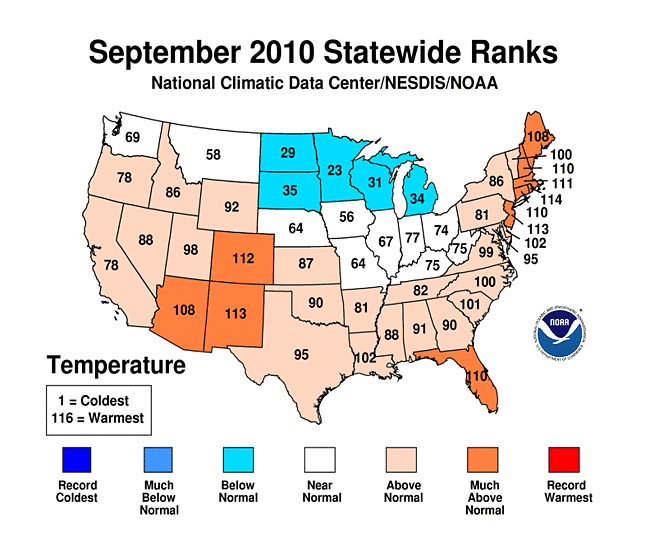
As indicated by the large number of daily record high temperatures in September, the month averaged above normal for the U.S. overall. According to the preliminary monthly analysis posted by NOAA's National Climatic Data Center within the last hour, the September monthly average was 1.7°F above the climatological mean. This was the 14th warmest September in 116 years of records and the 4th consecutive month with temperatures warmer than average.

Only 5 states (North and South Dakota, Minnesota, Michigan, and Wisconsin) averaged below normal, and no state was in the top 10 coolest Septembers. On the other hand, all New England states, except Vermont, had top-10 warmest Septembers. In addition, New Jersey, Florida, Colorado, New Mexico, and Arizona ranked in the top 10 of their respective temperature histories.

For the first 3 quarters of 2010 (January-September), the national average temperature was 1.0°F above the climatological mean. The Northeast region (Maryland northward through New England) had its warmest year-to-date on record at 3.3°F above average. On a statewide basis, all 6 of the New England states plus New Jersey had a record warm January-September. In addition, every other state from Virginia northeastward had a top-10 year-to-date. This included Maryland, Delaware, Pennsylvania, and New York. Despite the cool September, Michigan and Wisconsin also had top-10 warmest temperatures for the period. Texas (38th coolest) and Florida (22nd coolest) were the only 2 states to average below the long-term mean.

Images (click to enlarge): U.S. statewide average temperatures for September and 2010 year-to-date from National Climatic Data Center

Seasonal Outlook

Latest seasonal forecast: Click here.


Latest 3-month temperature outlook from Climate Prediction Center/NWS/NOAA.